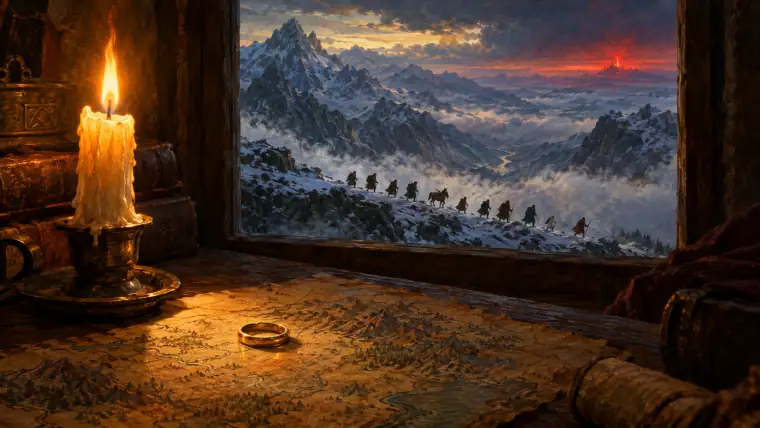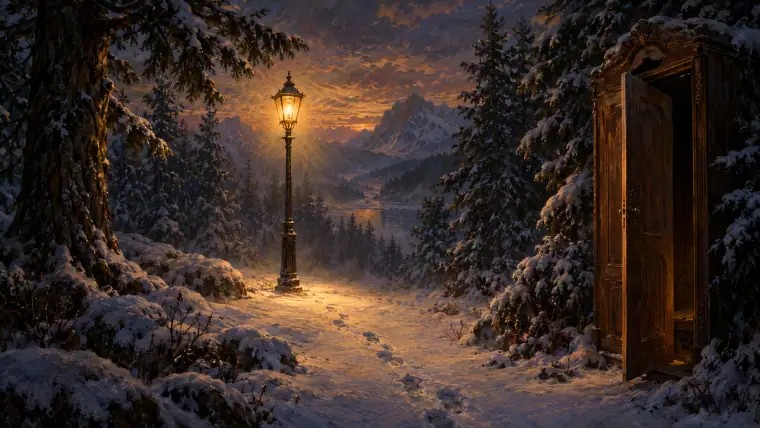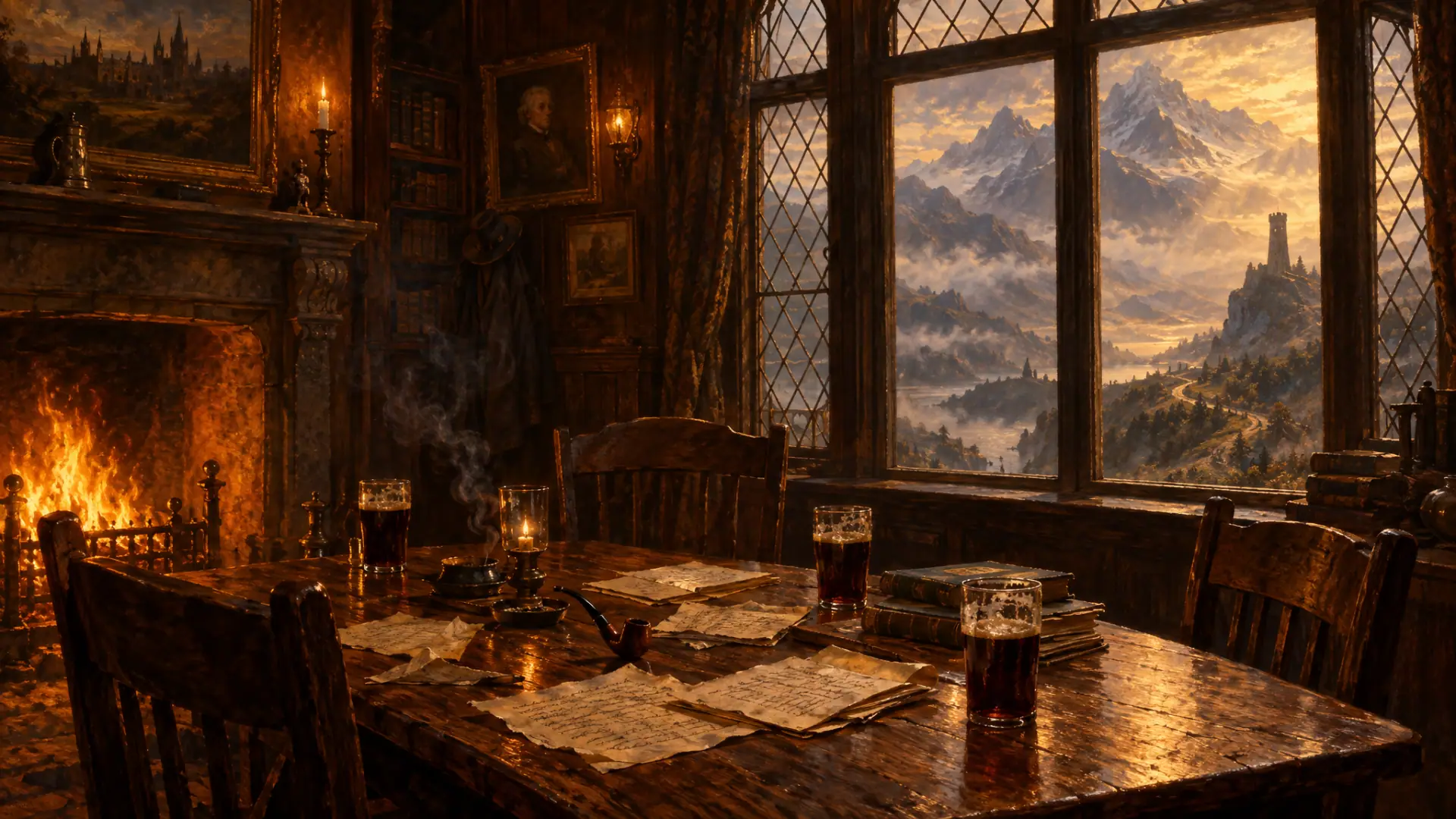
The Inklings gave Tolkien the audience and encouragement that carried The Lord of the Rings to completion, and gave Lewis the company in which Narnia took shape. Modern fantasy's two great secondary worlds were first heard in the same rooms.
What happened
The Inklings were never a society in any formal sense. They had no officers, no rules, no minutes, and no membership list beyond whoever C. S. Lewis and his friends happened to invite. What they had was a habit: from the early 1930s, a handful of Oxford dons and their friends met on Thursday evenings in Lewis's rooms at Magdalen College, and someone would pull out a manuscript and read.
The name was a hand-me-down. Around 1931 an undergraduate at University College, Edward Tangye Lean, had founded a club called the Inklings for reading aloud unfinished compositions. When Lean left Oxford in 1933 the club died, and Lewis and J. R. R. Tolkien carried its name over to their own gathering. The two men had met in 1926 at an English faculty meeting and had already bonded in Tolkien's Icelandic reading club, the Kolbítar, over the Norse sagas and Eddas. Their friendship deepened after a long night-time conversation about myth and truth with Hugo Dyson on Addison's Walk in September 1931, a conversation Lewis credited as a turning point on his road back to Christianity.
The core circle included Lewis's brother Warren ("Warnie"), the poet and novelist Charles Williams (who came to Oxford when Oxford University Press evacuated from London in 1939), the philosopher Owen Barfield, Dyson, Nevill Coghill, the physician Robert Havard, and later Tolkien's son Christopher. Alongside the Thursday readings, members met at midday, usually on Tuesdays, in the back parlor of the Eagle and Child pub on St Giles' — the "Rabbit Room" of the "Bird and Baby."
What was read in those rooms is now a literary canon. Tolkien brought chapters of the "new Hobbit," the sequel to The Hobbit that grew, over more than a decade, into The Lord of the Rings — sometimes read aloud by Christopher. Lewis read from Out of the Silent Planet; Williams read All Hallows' Eve. Not everyone was enthralled — Dyson's impatience with elves is one of the best-loved anecdotes of the group — but the reading continued.
The Thursday sessions faded in the autumn of 1949. Warren Lewis's diary records a night in October when no one turned up, and then, on 27 October, simply that there were no Inklings that evening. The pub meetings survived: in June 1950 Lewis handed round proofs of The Lion, the Witch and the Wardrobe, the first of The Chronicles of Narnia, at the Eagle and Child. When that pub was remodeled in 1962 the circle decamped across the road to the Lamb & Flag. Lewis died in November 1963.
Why it mattered
The Inklings mattered less as an influence than as an audience. Tolkien said as much: what he owed Lewis was not influence but "sheer encouragement." For years Lewis was the one reader who insisted the long, strange manuscript about hobbits and a ring must be finished, and the Thursday evenings gave Tolkien a deadline and an ear. Without them it is easy to imagine The Lord of the Rings abandoned in a drawer, as so much of what became The Silmarillion was.
The group also shared a creed. Tolkien, Lewis, Williams and Barfield all believed that myth and fairy-story were not childish things but serious vehicles of truth — the ideas behind Tolkien's Secondary world and Eucatastrophe. That conviction, argued out over tea and beer, is the intellectual root of modern High / Epic Fantasy. When The Lord of the Rings finally appeared from George Allen & Unwin in 1954–55, Lewis was among its first and loudest champions in print.
Legacy
The Inklings became the archetype of the writers' circle: friends who read drafts aloud and argue them into shape. The group's reputation grew enormously after the Tolkien boom of the 1960s ("Frodo Lives!"), and it gave its name and focus to the American The Mythopoeic Society, founded in 1967 to study Tolkien, Lewis and Williams together. Humphrey Carpenter's group biography The Inklings and the collections of the Marion E. Wade Center at Wheaton College in Illinois made the circle a scholarly field in its own right.
The downstream reach is vast. Middle-earth and Narnia shaped the Tolkien, Lewis & the Inklings and then the Paperback Boom & the Counterculture; their elves, dwarves and dark lords passed through Dungeons & Dragons into computer games and the screen, up to Peter Jackson's films. The Eagle and Child itself became a literary landmark: the pub where the modern fantasy tradition was, quite literally, first read aloud.
Marginalia
- The name was borrowed from an undergraduate club at University College founded around 1931 by Edward Tangye Lean; when he left Oxford in 1933, Tolkien and Lewis adopted it.
- Thursday-evening readings met in C. S. Lewis's rooms at Magdalen College; members also gathered at midday in the Rabbit Room of the Eagle and Child pub, nicknamed the 'Bird and Baby'.
- Chapters of what became The Lord of the Rings were read aloud to the group across the 1940s, sometimes by Tolkien's son Christopher.
- Warren Lewis's diary records the end of the Thursday readings: on 27 October 1949 he noted there were no Inklings that night.
- At an Eagle and Child gathering in June 1950, Lewis handed round proofs of The Lion, the Witch and the Wardrobe.
- When the Eagle and Child was remodeled in 1962 and the Rabbit Room lost its privacy, the surviving circle moved across St Giles' to the Lamb & Flag.
Quick answers
- What was The Inklings?
- A loose circle of Oxford friends who read unfinished manuscripts aloud over beer and pipe smoke — and in doing so midwifed Middle-earth and Narnia.
- When did The Inklings happen?
- c. 1933 – 1949 (readings); pub meetings into the 1960s.
- Why did The Inklings matter?
- The Inklings gave Tolkien the audience and encouragement that carried The Lord of the Rings to completion, and gave Lewis the company in which Narnia took shape. Modern fantasy's two great secondary worlds were first heard in the same rooms.