dnd was one of the first computer RPGs and among the most influential of the PLATO dungeon games: it introduced a multi-level dungeon with an ultimate treasure and a climactic guardian, and its ideas flowed into later microcomputer games.
Overview
If pedit5 was the first PLATO dungeon to survive, dnd was the one that lasted. Written by Gary Whisenhunt and Ray Wood, students at Southern Illinois University, in the TUTOR language for the PLATO network, The Game of Dungeons, universally called dnd after its lesson name and the abbreviation "D&D", dropped players into the multi-level Whisenwood Dungeon in search of an ultimate treasure: the Orb, guarded on the deepest levels by the Dragon. It was maintained and expanded for a decade, it is still playable, and it helped establish the shape of the computer dungeon crawl.
Origins
Whisenhunt and Wood took their inspiration from two sources: Dungeons & Dragons, published the year before, and Reginald Rutherford's pedit5 on the same network. Rutherford later said he knew of their project while writing his own; one account holds that the repeated deletion of pedit5 by PLATO administrators spurred the pair to finish theirs. Southern Illinois had a single PLATO terminal, and Whisenhunt became its administrator, which gave the project a home. Like other game authors, they faced administrators who regarded games as a misuse of the system.
The date is debated. PLATO lore and some references place dnd in 1974; the historian Aaron A. Reed, searching PLATO's archived notes files, found no mention of the game as late as June 1976 and argues for a first appearance around the fall of 1975 at the earliest, after pedit5. What is certain is that it was soon in wide use. Dirk Pellett, who arrived late in 1975 (at Iowa State University, by most accounts), sent so many suggestions that Whisenhunt and Wood gave him editing privileges. He added items, potions and encounters and refined the rules; his brother Flint, who attended the University of Illinois from 1977, helped program later editions, which continued into the mid-1980s. The earliest surviving version is 5.4 from 1977.
How it plays
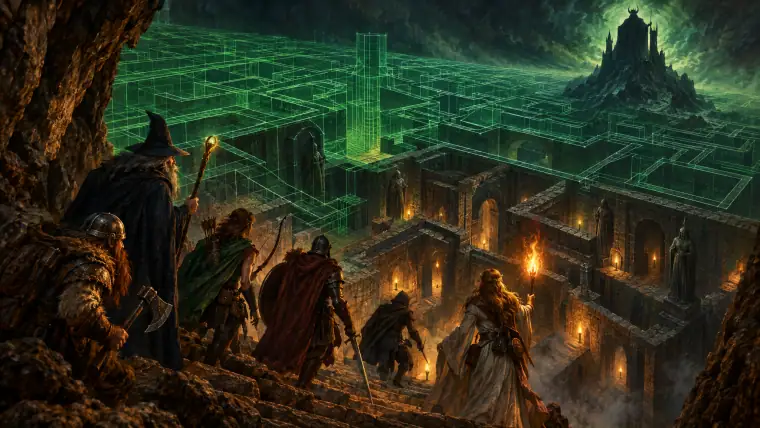
Players roll a character with D&D-style attributes (strength, intelligence, wisdom, dexterity) and enter the dungeon, viewed from above as a maze on PLATO's plasma screen. Each level is a labyrinth; players can press deeper or climb back toward the surface, making it one of the earliest games with non-linear progression between levels. Teleporters shift characters between depths. There are bottomless pits, trapped chests, potions with a range of effects, magic weapons and armor, and books that alter attributes when read. Early versions placed the Orb on levels 17 to 20, where a Dragon waits that can deal enormous damage; later editions, as preserved today, add a second great treasure, the Grail.
The economy is a neat loop. Gold means nothing inside the dungeon, but carried out it converts into hit points and spell capacity, so each expedition finances the next. Death is permanent: lose a character and you roll another. The designers also had a sense of humor, with joke spells such as "Kitchen Sink."
Reception & impact
dnd became one of PLATO's most popular games, and its influence traveled beyond the network. Daniel Lawrence, who had seen PLATO, wrote a version called DND for DEC PDP-10 and PDP-11 computers; Dirk Pellett later called it plagiarized, while allowing it some original programming. Lawrence's game evolved into Telengard, a commercial dungeon crawl for home computers in 1982. The line between these games and Rogue is harder to prove, but the CRPG Addict blog, which played dnd in 2012, considered the resemblance strong. Through the first-person PLATO games it helped inspire, Moria and Oubliette, its lineage also reaches Wizardry.
Legacy
dnd is widely credited with the first video-game boss: a single, singularly powerful guardian standing between the player and victory. Its dungeon of many levels, ultimate treasure at the bottom, and the return to town to convert loot into power is still the skeleton of the dungeon crawl from Diablo onward. The game has existed continuously in some form since its first edition, and the Pellett-era versions run today on Cyber1's revived PLATO, where Dirk Pellett also wrote down much of its history.
Marginalia
- The title screen says The Game of Dungeons; history remembers it by its PLATO lesson name, dnd.
- 'Whisenwood,' the dungeon's name, fuses the surnames of its authors, Gary Whisenhunt and Ray Wood.
- The Dragon guarding the Orb is often cited as the first boss in a video game.
- Gold carried out of the dungeon converted into hit points and spell capacity for the next trip.
- Dirk Pellett had so many suggestions after arriving in late 1975 that the authors gave him editing rights; his brother Flint joined later.
- Daniel Lawrence's DND for DEC computers, ancestor of the 1982 game Telengard, borrowed heavily from it.
Quick answers
- When was dnd first released?
- dnd was first released in c. 1975 (PLATO); revised into the 1980s.
- What kind of work is dnd?
- dnd is a dungeon crawler in the First-Person Dungeon Crawlers ('Blobbers') and Western Computer RPGs (CRPG) tradition, released for PLATO.
- Why is dnd important?
- dnd was one of the first computer RPGs and among the most influential of the PLATO dungeon games: it introduced a multi-level dungeon with an ultimate treasure and a climactic guardian, and its ideas flowed into later microcomputer games.