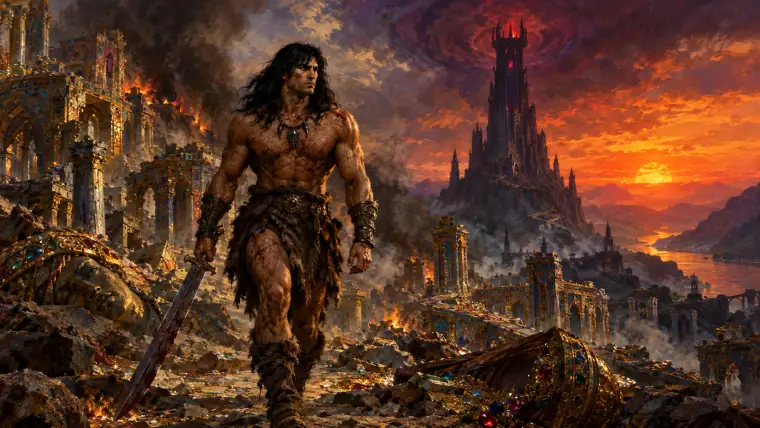
Frazetta's paperback covers gave sword and sorcery its definitive image just as the fantasy paperback boom began, and his visual vocabulary flowed directly into game art, album covers, and fantasy film.
Life
Frank Frazzetta was born on February 9, 1928, in Sheepshead Bay, Brooklyn, the only boy in an Italian-American family with three daughters. His grandmother, he later said, paid him a penny a drawing to keep going. At eight he was enrolled at the Brooklyn Academy of Fine Arts, a small school run by the Italian instructor Michele Falanga, though Frazetta insisted he learned more from his fellow students than from any lesson. He was also a formidable baseball player, good enough that the New York Giants offered him a contract in 1948. He chose art, and trimmed the second "z" from his surname along the way.
He entered the comics business at sixteen, in 1944, cleaning up pencils in Bernard Baily's studio, and spent the next decade drawing westerns, romance, war, and funny-animal stories for publishers whose credits were rarely recorded. From 1954 to 1961 he worked in Al Capp's studio on the Li'l Abner Sunday page, a job he quit in a dispute over pay. He married Eleanor "Ellie" Kelly in 1956; she became his business partner and the fierce guardian of his originals. In his last decades Frazetta suffered a long-untreated thyroid condition and a series of strokes that left his right arm almost useless, and he retrained himself to paint with his left hand. Ellie died in July 2009, and a painful family dispute over the collection followed before it was settled in April 2010. Frazetta died of a stroke on May 10, 2010, near his home in Florida.
Work
The turn came in 1964, when a painting of Ringo Starr for a Mad magazine ad parody caught the eye of United Artists, which hired him to paint the poster for What's New Pussycat? He reportedly earned a year's salary in an afternoon. At the same moment the paperback houses were discovering fantasy. Beginning in 1966, Frazetta painted covers for most of the volumes in Lancer Books' Conan series, which reprinted Robert E. Howard's stories from Weird Tales alongside pastiches by L. Sprague de Camp and Lin Carter.
Those covers changed everything. Howard's Conan had been drawn before, but Frazetta's barbarian was a mass of straining muscle, half-lit, standing on a pile of the slain under a bruised sky, with a woman draped at his feet and a monster coiling out of the dark. He freely admitted that the paintings only coincidentally matched the text: "I didn't read any of it," he said. "I drew him my way." The books sold, and the look became the look of Sword & Sorcery.
He worked mostly in oil, but also in watercolor, ink, and pencil. Through the late 1960s and 1970s he painted covers for James Warren's black-and-white horror magazines Creepy, Eerie, and Vampirella, as well as Edgar Rice Burroughs reprints, film posters, and album art. His 1973 painting Death Dealer, a horned, shadow-faced rider with a bloody axe, became the cover of Molly Hatchet's 1978 debut album and spawned novels, statues, and comics. In 1966 he won the Hugo Award for Best Professional Artist.
In the early 1980s he partnered with his friend Ralph Bakshi on Fire and Ice (1983), an animated feature built by rotoscoping live-action footage so that the characters would move like Frazetta paintings. The two men were involved in everything from casting to the final shoot. The film was a commercial failure, arriving in the wake of Conan the Barbarian (1982), but it remains the purest translation of his style to the screen. Afterward he returned to painting and ran a gallery and museum in East Stroudsburg, Pennsylvania, and later on his estate in the Poconos.
Legacy
It is difficult to overstate how much of fantasy's visual grammar is Frazetta's. The heavy-limbed warrior, the chiaroscuro battlefield, the monster emerging from shadow: these became the default imagery of 1970s and 1980s paperbacks, heavy-metal album sleeves, fantasy calendars, and eventually the boxes and rulebooks of the roleplaying-game boom. Artists of the next generation grew up on him directly. John Howe, who would help design Peter Jackson's Middle-earth, collected Frazetta's paperback covers as a boy. George Lucas collected his originals, and Guillermo del Toro called him "an Olympian artist that defined fantasy art for the 20th century."
The honors followed: induction into the Will Eisner Comic Book Hall of Fame and the first Spectrum Grand Master Award (both 1995), the Society of Illustrators Hall of Fame (1998), a World Fantasy Convention Life Achievement Award (2001), and the Science Fiction Hall of Fame (2014). The market caught up too. Metallica guitarist Kirk Hammett paid a reported $1 million in 2009 for the original cover of Conan the Conqueror; Egyptian Queen sold for $5.4 million in 2019; and Dark Kingdom sold for $6 million in 2023, a record for fantasy art at the time.
Frazetta sits at the hinge of this museum's story. He took pulp-era fiction that had lived in cheap magazines and gave it the grandeur of oil painting just as the Paperback Boom & the Counterculture and Tolkien craze were creating a mass audience for fantasy. When the first generation of Dungeons & Dragons players tried to picture their fighters and their dungeons, many of them were picturing a Frazetta, whether they knew his name or not.
Marginalia
- Born Frank Frazzetta in 1928, he dropped one 'z' early in his career because he thought the spelling looked clumsy.
- A gifted ballplayer, he was offered a professional contract by the New York Giants in 1948 and turned it down to draw.
- He admitted he did not read the Conan stories before painting them: he drew the barbarian 'my way,' and readers never complained.
- His 1973 painting Death Dealer became the cover of Molly Hatchet's 1978 debut album and later a mascot of the U.S. Army's III Corps.
- He won the Hugo Award for Best Professional Artist in 1966 and was the first recipient of the Spectrum Grand Master Award, in 1995.
- After strokes left his right arm nearly paralyzed, he taught himself to paint left-handed.
- His painting Egyptian Queen sold for $5.4 million at Heritage Auctions in May 2019, then a world record for comic art.
Quick answers
- Who was Frank Frazetta?
- The Brooklyn painter whose muscular, storm-lit Conan covers of the 1960s taught the world what sword and sorcery should look like, and whose shadow falls across every barbarian since.
- When was Frank Frazetta born?
- Frank Frazetta was born in 1928 in Sheepshead Bay, Brooklyn, New York and died in 2010.
- What is Frank Frazetta known for?
- Frank Frazetta is best known for Conan the Cimmerian.
- Why does Frank Frazetta matter to fantasy and games?
- Frazetta's paperback covers gave sword and sorcery its definitive image just as the fantasy paperback boom began, and his visual vocabulary flowed directly into game art, album covers, and fantasy film.