The dispute is the founding quarrel of the roleplaying hobby. It turned on the difference between an idea and a product, shaped how credit and royalties worked at TSR, and still colors how the game's origins are told.
What happened
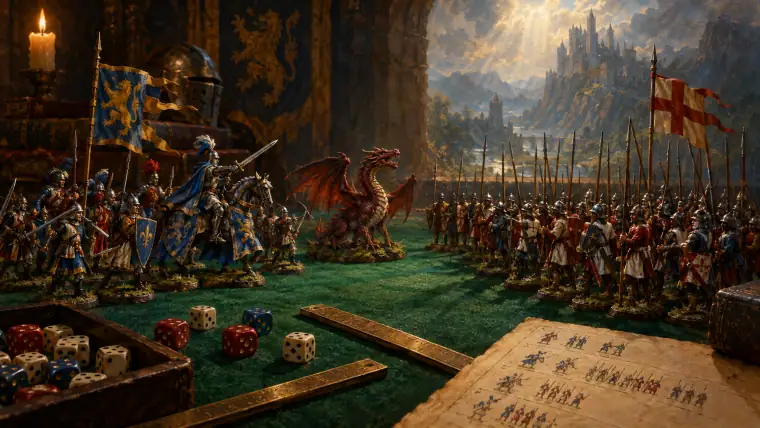
The two men met at Gen Con in August 1969, a Lake Geneva insurance underwriter and a young Minnesota wargamer from the Twin Cities. In 1971 Dave Arneson, drawing on the refereed role-play of David Wesely's Braunstein games and the fantasy rules of Gary Gygax and Jeff Perren's Chainmail, began running a campaign set in the barony of Blackmoor. His players each controlled a single hero who carried over from session to session, grew in ability, and ventured into the dungeons beneath Blackmoor Castle. In the winter of 1972–73 Arneson and a friend traveled to Lake Geneva to show their games to Gygax, who was then advising a small publisher. Gygax was electrified by Blackmoor.
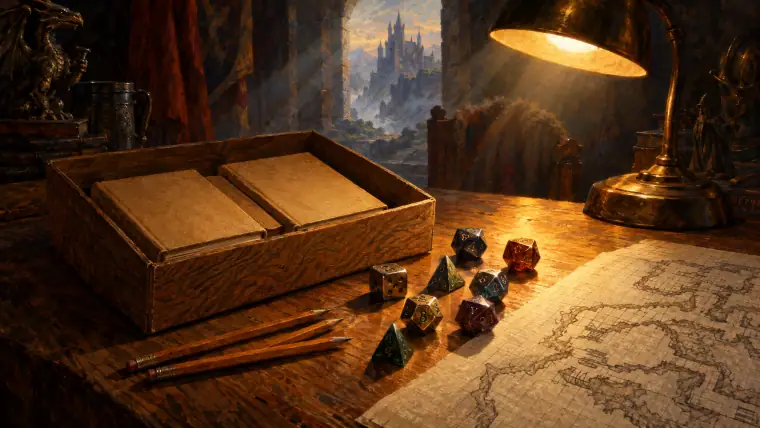
What followed is the heart of the dispute. Gygax tested the ideas with his own players in a campaign he called Greyhawk, exchanged notes with Arneson, and wrote the manuscript. Gygax felt rivals might beat them to print, so the rules were put together quickly; Arneson's own final draft was never used. When Tactical Studies Rules published Dungeons & Dragons in January 1974, three little booklets in a woodgrain box, the cover credited "Gary Gygax & Dave Arneson." The first thousand copies sold within a year. Arneson's Blackmoor supplement followed in 1975, including "The Temple of the Frog," the first published adventure written for other referees to run.
Why it mattered
The partnership frayed quickly. Arneson joined TSR as Director of Research at the start of 1976 and left before the end of the year; accounts point to creative differences between the two. TSR had agreed to pay Arneson a royalty on D&D products. But in 1977 the company launched Advanced Dungeons & Dragons, a new and far more elaborate system written by Gygax, while continuing the simpler line through the Basic Set. TSR maintained that AD&D was a significantly different game and paid Arneson nothing on it. As AD&D became the company's flagship, the difference was worth a fortune.
In 1979 Arneson sued, the first of five lawsuits against Gygax and TSR. The core question was not only money but authorship: whose game was it? Gygax's defenders pointed to the rules text, the systems and the publishing gamble; Arneson's to the campaign that had invented the play experience itself. In March 1981 the suits were settled out of court in a confidential agreement. Both men would be credited as "co-creators" on D&D packaging, and Arneson would receive a 2.5 percent royalty on all AD&D products, which gave him a six-figure annual income for years.
Legacy
The settlement did not end the bitterness, and for decades each man's admirers told the story their own way. The two did reconnect for a time in the mid-1980s, while Gygax was president of TSR, and Arneson agreed to bring Blackmoor back into D&D through the DA series of modules, published in 1986–87. By then Gygax had lost his own fight for the company, ousted in October 1985 when Lorraine Williams took control; TSR's editors reworked Arneson's manuscripts to fit their house setting and dropped his projects before a planned fifth module appeared. When Wizards of the Coast bought TSR in 1997, Peter Adkison paid Arneson an undisclosed sum to clear his remaining royalty rights, which allowed the next edition to be called simply Dungeons & Dragons.
Gygax died on March 4, 2008, and Arneson on April 7, 2009. Historians have since tried to put the story on firmer ground. Jon Peterson's Playing at the World (2012) reconstructed the design history from letters, fanzines and drafts, and his Game Wizards (2021) chronicled the business and legal battles in detail. Many historians now describe D&D as a genuine collaboration in which Arneson's campaign supplied the revolutionary form and Gygax's writing and publishing turned it into a game others could play. The quarrel endures because both claims are true.
Marginalia
- Dave Arneson's Blackmoor campaign in the Twin Cities, begun in 1971 with modified Chainmail rules, introduced the dungeon expedition and the single persistent character.
- In the winter of 1972–73 Arneson demonstrated Blackmoor to Gary Gygax in Lake Geneva; Gygax then wrote the draft that became D&D, trading notes with Arneson.
- The 1974 boxed set credited "Gary Gygax & Dave Arneson"; its first print run of 1,000 sold out within a year.
- Arneson joined TSR as Director of Research at the start of 1976 and left before the year was out.
- TSR paid Arneson royalties on D&D but not on AD&D, arguing it was a different game; in 1979 he filed the first of five lawsuits.
- In March 1981 the suits were settled confidentially: both men would be credited as "co-creators," and Arneson would receive a 2.5 percent royalty on AD&D.
- In 1997 Wizards of the Coast founder Peter Adkison paid Arneson an undisclosed sum to free D&D of the royalty, letting Wizards drop the word "Advanced."
Quick answers
- What was The Gygax–Arneson Disputes?
- Who invented Dungeons & Dragons? The question sent Dave Arneson to court against Gary Gygax and TSR in 1979, ended in a 1981 settlement naming both men co-creators, and has divided fans ever since.
- When did The Gygax–Arneson Disputes happen?
- 1979 – 1981 (and long after).
- Why did The Gygax–Arneson Disputes matter?
- The dispute is the founding quarrel of the roleplaying hobby. It turned on the difference between an idea and a product, shaped how credit and royalties worked at TSR, and still colors how the game's origins are told.