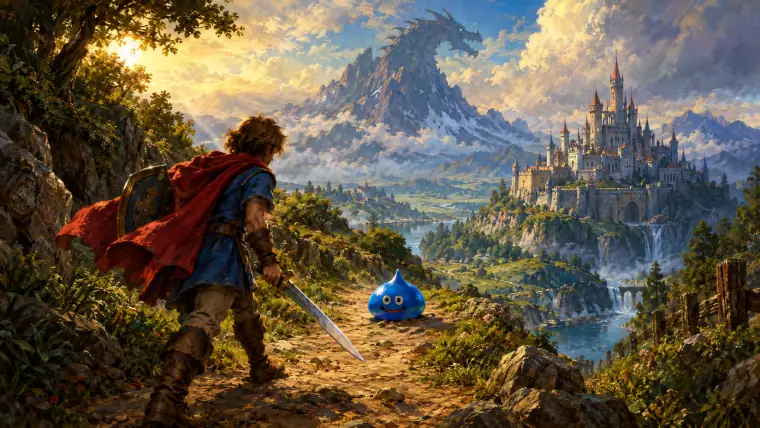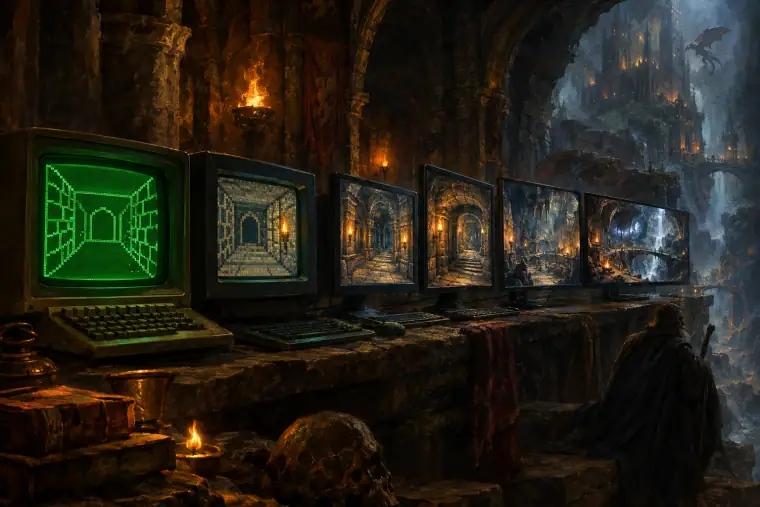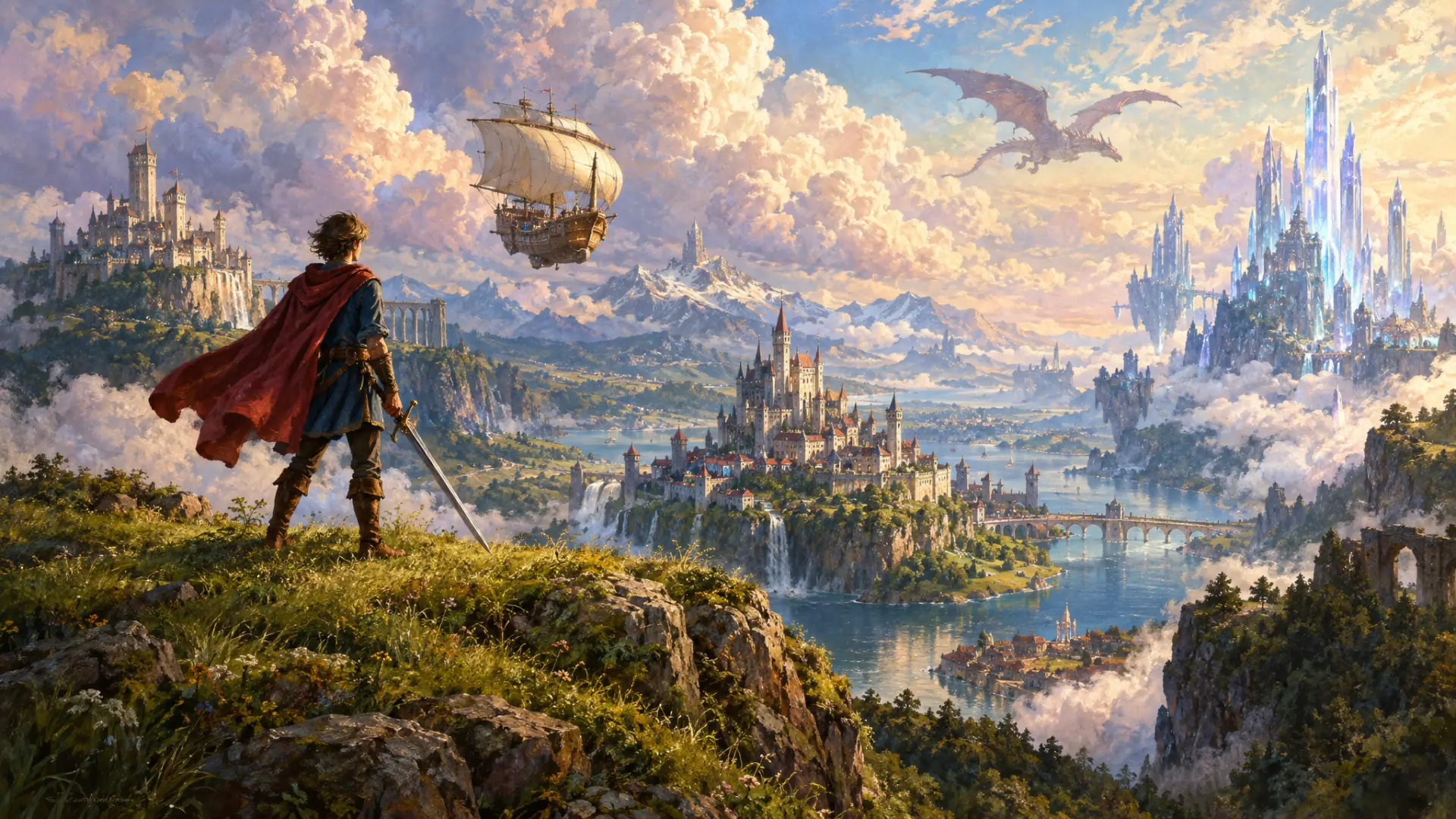
Hydlide was one of the founding Japanese action RPGs and an early open-world game; its regenerating health, attack and defense modes and save-anywhere design influenced Ys and later designers, even as its belated NES release made it a byword for dated design in the West.
Overview
In the kingdom of Fairyland, three magic jewels kept the demon Varalys sealed away. When an evil man stole them, Varalys broke free, turned Princess Ann into three fairies and hid her across the land, and loosed his monsters. The young knight Jim sets out alone. Hydlide, designed by Tokihiro Naito and released by T&E Soft for NEC's PC-6001 and PC-8801 on December 13, 1984, is one of the founding Japanese action RPGs: a real-time adventure across an open overhead world of fields, forests and dungeons, where the hero grows stronger by fighting.
Origins
Naito wanted to fuse action and role-playing into a new genre. His models were Japanese: Namco's arcade game The Tower of Druaga (1984), whose real-time maze combat he admired most, and The Black Onyx (1984), whose RPG elements and visible health bar he adopted. He later said he knew nothing of Western RPGs like Ultima or Wizardry, having never used an Apple II. During development he read in a magazine about two rival projects, Nihon Falcom's Dragon Slayer and Courageous Perseus, and was shocked to learn others were chasing the same idea. He underestimated Dragon Slayer, which became his biggest competitor.
How it plays
Hydlide essentially spreads Druaga's formula across a colorful open world and adds statistics. Jim walks the overworld and attacks by moving into enemies, choosing between an attack mode, which deals damage, and a defense mode, which protects him. Experience from each victory raises his level and strength. Its signature idea was regenerating health: standing still slowly restores hit points, a mechanic that decades later became standard in shooters such as Halo. Players could also save and load at any moment. Exploration turns up equipment and treasure, and the search for the three hidden fairies drives the quest toward Varalys.
Reception & impact
In Japan Hydlide was praised as an innovator and sold heavily. By one widely reported tally it sold 2 million copies there across all versions, about a million on home computers and a million for the Famicom version, Hydlide Special (1986), and it was the first computer game to receive Toshiba EMI's Platinum award for a million sales. It shaped the action RPGs that followed, including Falcom's Ys, which used a similar health-regeneration idea. Designer Hideo Kojima has said he built Metal Gear Solid V: The Phantom Pain to recapture the open-world feeling he had playing Hydlide on PC, and Hideki Kamiya cited the series as an influence too.
The West saw it differently. Apart from a European MSX release, English-speaking players met Hydlide only in 1989, when Fujisankei Communications International released the Famicom version on the NES almost unchanged. Arriving three years after The Legend of Zelda, it looked primitive beside Nintendo's game, and its short, endlessly repeating overworld tune, often compared to the Indiana Jones march and Disney's "It's a Small World," became notorious among NES owners. Retrospective Western reception has been mostly negative, a case of a pioneer judged out of its time.
Legacy
The series continued with Hydlide II: Shine of Darkness (1985), which introduced a morality meter: kill humans or good monsters and townsfolk refuse to help you. Hydlide 3: The Space Memories (1987) added character classes, an in-game clock, and needs for sleep and food, and appeared on the Mega Drive as Super Hydlide. Virtual Hydlide (1995) remade the original for the Sega Saturn with randomly assembled maps. With Dragon Slayer and The Black Onyx, Hydlide formed the home-computer foundation of Japanese RPG design that Dragon Quest would carry to consoles, and in 2023 a port of the PC-8801 version arrived on the Nintendo Switch.
Marginalia
- Tokihiro Naito said he had never used an Apple II and knew nothing of Ultima or Wizardry while making it.
- It borrowed the visible health bar from The Black Onyx and made health regenerate when the hero stood still.
- Players can toggle between an attack mode and a defense mode as they walk into enemies.
- It reportedly sold 2 million copies in Japan, and was the first computer game to receive Toshiba EMI's Platinum award for a million sales.
- Its NES version arrived in North America in 1989, three years after The Legend of Zelda, and suffered by comparison.
- Hydlide II: Shine of Darkness (1985) added an early morality meter that changed how townsfolk treated the player.
- Hideo Kojima has cited the open-world feel of Hydlide on PC as an inspiration for Metal Gear Solid V.
Quick answers
- When was Hydlide first released?
- Hydlide was first released in 1984 (PC-6001 / PC-8801, Japan).
- What kind of work is Hydlide?
- Hydlide is an action RPG in the Action RPGs & Hack-and-Slash, Japanese RPGs (JRPG) and Open-World RPGs tradition, released for PC-6001, PC-8801, MSX, MSX2, FM-7, PC-9801, Sharp X1, Sharp MZ-2000, Famicom (Hydlide Special, 1986), NES (1989) and Nintendo Switch (2023).
- Why is Hydlide important?
- Hydlide was one of the founding Japanese action RPGs and an early open-world game; its regenerating health, attack and defense modes and save-anywhere design influenced Ys and later designers, even as its belated NES release made it a byword for dated design in the West.