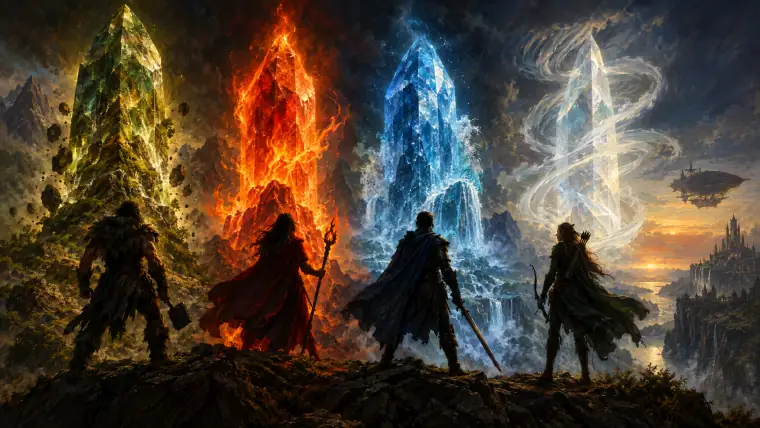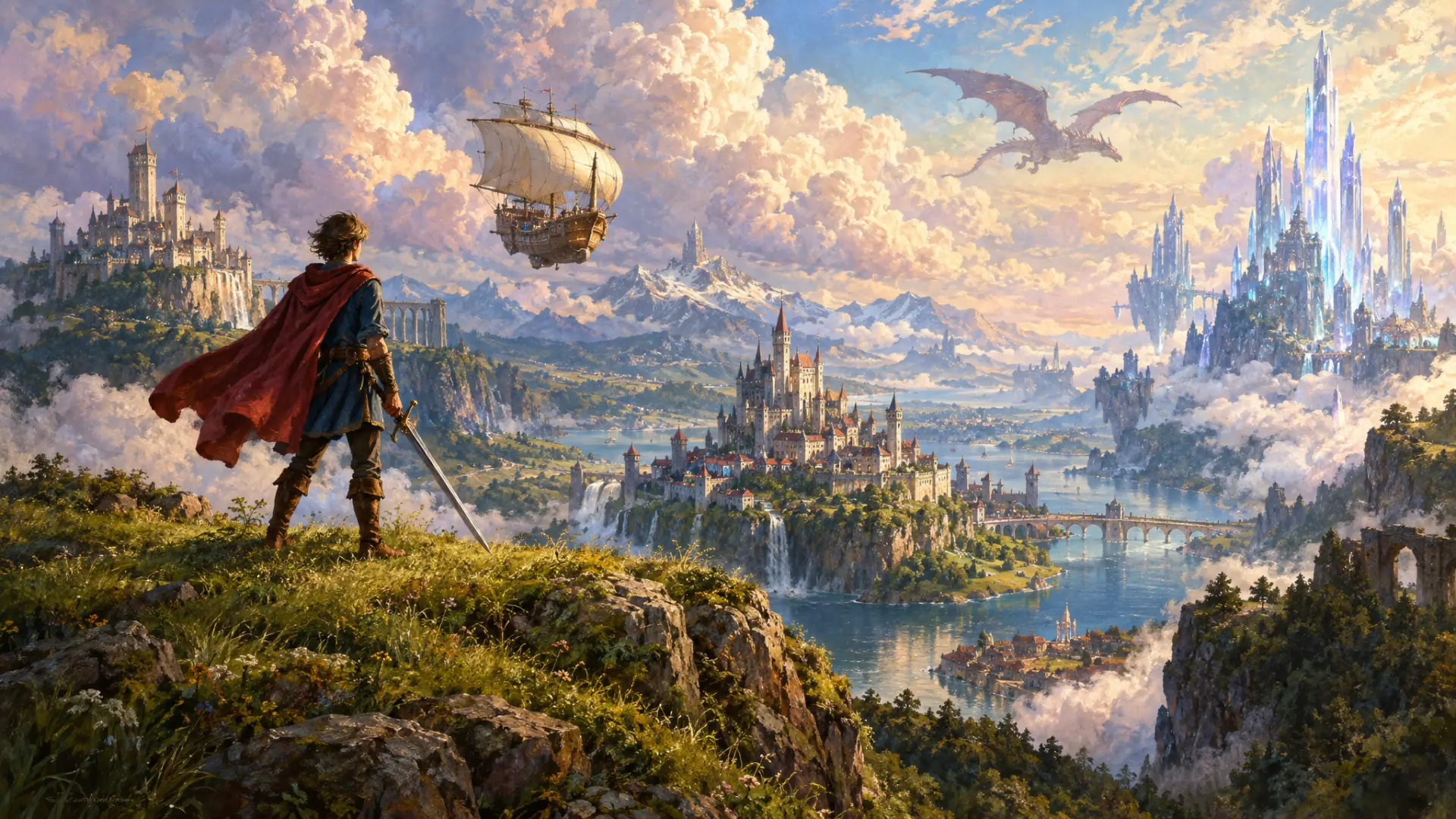
The last Final Fantasy built from 2D sprites, it traded a single hero for an ensemble of fourteen, darkened the series' themes, and is widely ranked among the greatest RPGs ever made.
Overview
Final Fantasy VI is the sixth main entry in Square's series, released for the Super Famicom in Japan on April 2, 1994. In North America it appeared on the Super NES in October 1994 as Final Fantasy III: only the first game and the fourth (sold as Final Fantasy II) had been released there, so Square kept the numbering continuous. Every later version restored the original title.
It is the series' last game built from 2D sprites and its first not directed by creator Hironobu Sakaguchi, who produced. The setting leaves medieval fantasy behind for a world of steam, steel and opera houses where magic has faded into legend — until the Gestahl Empire begins draining it from captured Espers to power soldiers and war machines. Against the Empire stand the Returners, a rebel movement, and a cast that grows to fourteen permanent playable characters.
Origins
Development began after Final Fantasy V shipped in December 1992 and took about a year, with a team of roughly thirty — large for the time. Sakaguchi, by then a Square executive vice president, supplied the premise and supervised while two directors split the work: Yoshinori Kitase ran events and the scenario, and Hiroyuki Ito handled everything to do with battles. The guiding idea was that every character is the protagonist. Staff across the team pitched characters and their "episodes": Sakaguchi created Terra and Locke, Kitase created Celes and Gau, and Tetsuya Nomura created Shadow and Setzer. Kitase wove the pieces together and wrote some of the most remembered scenes himself, including the opera and Celes's suicide attempt, as well as every appearance of the villain Kefka.
Yoshitaka Amano returned for character and concept art, while Kazuko Shibuya drew the detailed in-game sprites and Tetsuya Takahashi designed the Magitek armor of the opening scene. Nobuo Uematsu wrote a score built on leitmotifs — a theme for each major character — including the "Aria di Mezzo Carattere," sung by a synthesized voice because the hardware could not play a recorded one, and "Dancing Mad," a roughly 17-minute final-battle piece with an organ cadenza.
How it plays
Menu-driven battles use the series' Active Time Battle system, introduced in Final Fantasy IV: each fighter's gauge fills according to speed, and when it is full the player chooses an action. Up to four characters fight at once, each with a signature skill — Locke steals, Celes's Runic absorbs spells, Sabin performs martial-arts techniques by entering button combinations — and a character near death may unleash a Desperation Attack, a forerunner of the Limit Breaks of later games. A second player can take control of some characters in battle.
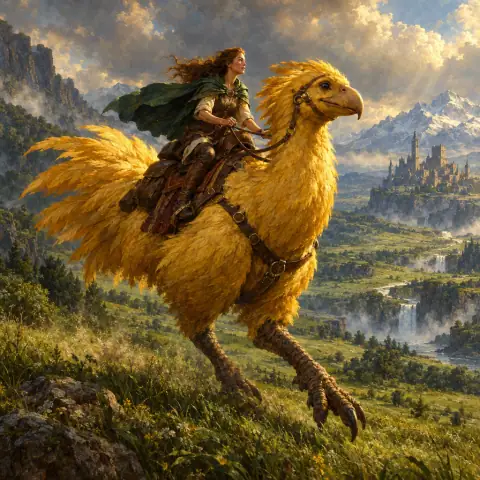
Magic is learned from magicite, the crystallized remains of Espers. Equipping a shard teaches its spells over time, can boost statistics on level-up, and lets its bearer summon the Esper — so almost anyone can become a caster. Relics, a new class of accessories, reshape battle commands. The party travels on foot, by chocobo and by airship across a world map drawn with the Super NES's Mode 7 effects.
The story
Terra Branford, a half-human, half-Esper girl enslaved by the Empire with a mind-control crown, is freed during a raid in the mining town of Narshe and joins the Returners. The quest to understand her power leads to the Esper world and to disaster: Kefka Palazzo, the Empire's first experimental Magitek Knight, driven insane by the process, murders Emperor Gestahl, seizes the statues of the Warring Triad and upsets the balance of magic, shattering the world. The second half opens a year later in the World of Ruin. Celes wakes on a deserted island, and the player gathers the scattered survivors in almost any order before storming Kefka's tower. The story deals with war crimes, including the poisoning of the kingdom of Doma's water supply, grief, redemption and orphaned children, in tones darker and more mature than earlier entries.
Reception & impact
Square reported 2.55 million copies sold in Japan by mid-1994, making it the country's best-selling game of the year. In the United States it topped the SNES sales chart in October and was the year's eighth best-selling Super NES cartridge, though Sakaguchi later said it was not a commercial success there. By March 2003 the Super NES and PlayStation versions had shipped 3.48 million copies. Electronic Gaming Monthly named it the Best Role-Playing Game of 1994, and critics continue to rank it as the best Final Fantasy and one of the greatest games ever made; IGN placed it ninth among the top games of all time in 2007, and Kefka is often cited as one of the most memorable villains in RPGs.
Ted Woolsey's English translation added its own flavor while working under Nintendo of America's content guidelines: nudity was removed, a bar became a café, the spell Holy became Pearl, and Tina was renamed Terra.
Legacy
After VI, Square experimented with a 3D battle demo using Terra, Locke and Shadow, then moved Final Fantasy VII to the CD-based PlayStation — a break with Nintendo so deep that no new mainline Final Fantasy was released on a Nintendo platform until an abridged Final Fantasy XV: Pocket Edition reached the Switch in 2018. VI has been re-released on the PlayStation (1999), the Game Boy Advance (2006), mobile, PC and the 2022–24 Pixel Remaster line. Together with Chrono Trigger (1995), it stands as the high-water mark of the 16-bit Japanese RPG.
Marginalia
- It came out in Japan on April 2, 1994; in North America it was sold as Final Fantasy III in October 1994, because only two earlier entries had been released there.
- It is the first main Final Fantasy not directed by Hironobu Sakaguchi; Yoshinori Kitase and Hiroyuki Ito shared the job.
- Its fourteen permanent playable characters are the most in any main-series Final Fantasy.
- The opera sequence's "Aria di Mezzo Carattere" uses a synthesized voice because the sound chip could not carry a real vocal.
- Kefka's final-battle theme, "Dancing Mad," runs about 17 minutes; the ending theme is over 21.
- Square reported 2.55 million copies sold in Japan by mid-1994, the country's best-selling game that year.
- It was the last new mainline Final Fantasy on a Nintendo platform until 2018; its successor moved to Sony's PlayStation.
Quick answers
- When was Final Fantasy VI first released?
- Final Fantasy VI was first released in 1994 (Super Famicom, Japan, April; SNES as Final Fantasy III, North America, October).
- Who created Final Fantasy VI?
- Final Fantasy VI was made by Hironobu Sakaguchi (producer; story premise), Yoshitaka Amano (character & image design) and Nobuo Uematsu (composer).
- Who published or developed Final Fantasy VI?
- Square / Square Enix.
- What kind of work is Final Fantasy VI?
- Final Fantasy VI is a Japanese RPG in the Japanese RPGs (JRPG) tradition, released for Super Famicom / SNES, PlayStation, Game Boy Advance, Virtual Console, Android & iOS, Windows, Nintendo Switch, PlayStation 4 and Xbox Series X/S.
- Why is Final Fantasy VI important?
- The last Final Fantasy built from 2D sprites, it traded a single hero for an ensemble of fourteen, darkened the series' themes, and is widely ranked among the greatest RPGs ever made.