Virtual economies turned MMORPGs into objects of serious economic, legal and ethical study, created an international gold-farming industry, and forced developers to become central bankers of their own worlds.
What happened
As soon as online worlds had scarce items and persistent characters, players began selling them. In the late 1990s owners of Ultima Online and the Korean hit Lineage listed swords, houses, and gold on eBay and settled up through PayPal, and EverQuest (1999) quickly followed. Nobody had designed these markets; they grew from the simple fact that powerful gear took hundreds of hours of Grinding to acquire, and some people had more money than time.
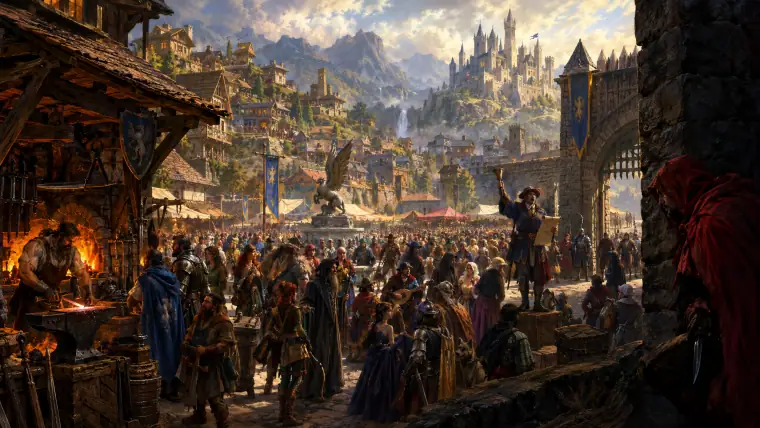
In December 2001 the economist Edward Castronova, then at California State University, Fullerton, published "Virtual Worlds: A First-Hand Account of Market and Society on the Cyberian Frontier." Treating EverQuest's world of Norrath as a country, he used auction prices to estimate its output. Norrath's GNP per capita came to about $2,266, putting it between Russia and Bulgaria; a player farming the game earned the equivalent of roughly $3.42 an hour; and the platinum piece traded higher than the yen or the lira. The paper became one of the most downloaded on the Social Science Research Network and made "the GDP of Norrath" a headline around the world. Castronova later expanded his work into the book Synthetic Worlds (2005) and co-founded the scholarly blog Terra Nova with Julian Dibbell, Dan Hunter, and Greg Lastowka.
Meanwhile the trade professionalized. In 2001 two EverQuest players, Brock Pierce and Alan Debonneville, founded Internet Gaming Entertainment (IGE), a real-money broker with customer service staff and an operation in Hong Kong. The same year, reports described Korean internet cafés being converted into "gold farms," where hired players ground for currency around the clock. The model moved to mainland China as World of Warcraft (2004) exploded, and in 2005 The New York Times estimated that more than 100,000 people worked full-time as gold farmers in China. Estimates of the global market in the mid-2000s ranged from hundreds of millions of dollars to IGE's own claim of $880 million in 2005; all such figures were speculative. Julian Dibbell chronicled his year as a virtual-goods trader in Play Money (2006).
Why it mattered
Virtual economies turned fantasy into a subject for economists, lawyers, and development scholars. Researchers showed that players behaved like textbook consumers, buying less when prices rose. Lawyers debated whether a magic sword was property, and tax scholars whether selling it was taxable income. Gold farming was even discussed, by the University of Manchester's Richard Heeks among others, as a possible engine of development; one comparison found that gold farmers kept a larger share of sale revenue than growers of fair-trade coffee.
For players the effects were more immediate. Gold sellers spammed chat channels, bots camped the best hunting grounds, and inflation, sometimes called "mudflation," eroded the value of hard-won Loot & loot tables. Developers found that account theft, phishing, and stolen credit cards were tied to the trade, and many banned real-money trading outright in their terms of service. Game designers had to become monetary authorities, balancing currency "faucets" such as quest rewards against "sinks" such as repair costs and taxes.
Companies fought back in different ways. eBay stopped allowing auctions of most online-game goods in January 2007. Jagex took the drastic step of removing free trade and the Wilderness's player-versus-player combat from RuneScape in 2007, after gold farmers' fraud threatened its payment processing, and restored them only on February 1, 2011. Blizzard banned gold-farming accounts in large waves and campaigned publicly against gold sellers as a source of account theft.
Legacy
Eventually many developers decided that if players would trade real money for virtual goods, the developers should run the market. EVE Online created an official item redeemable for subscription time and tradable for in-game currency; Blizzard opened a real-money auction house in Diablo III in 2012, then closed it in March 2014, and in 2015 introduced the WoW Token, bought with cash and sold for gold. Free-to-play games built entire business models on premium currencies and microtransactions, and the gacha boom followed.
The questions Castronova raised in Norrath, about value, labor, and who owns a world, never went away. They returned with in-game skin markets, cryptocurrency "play-to-earn" games, and every debate over whether an MMORPG is a game or a job. For this museum, they mark the moment the fantasy economy of D&D's gold pieces and treasure tables collided with the real one.
Marginalia
- Edward Castronova's 2001 paper estimated Norrath's GNP per capita at $2,266, between Russia's and Bulgaria's.
- By Castronova's estimate, an EverQuest player 'earned' about $3.42 an hour by farming items and selling them for real money.
- EverQuest players Brock Pierce and Alan Debonneville founded Internet Gaming Entertainment (IGE) in 2001 to sell virtual goods.
- The New York Times estimated in 2005 that more than 100,000 people worked full-time as gold farmers in China.
- eBay stopped allowing sales of virtual goods from online games in January 2007.
- RuneScape removed free trade and Wilderness combat in 2007 to fight real-money trading, and restored them on February 1, 2011.
- Blizzard's Diablo III launched in 2012 with an auction house that traded items for real money; it closed in March 2014.
Quick answers
- What is Virtual Economies, Gold Farming & the GDP of Norrath?
- When an economist calculated in 2001 that EverQuest's Norrath had a per-capita GNP between Russia's and Bulgaria's, he revealed that fantasy worlds had grown real economies, with labor, inflation and sweatshops.
- When did Virtual Economies, Gold Farming & the GDP of Norrath begin?
- 1997 to the present.
- Why does Virtual Economies, Gold Farming & the GDP of Norrath matter?
- Virtual economies turned MMORPGs into objects of serious economic, legal and ethical study, created an international gold-farming industry, and forced developers to become central bankers of their own worlds.